

The Psychology of Procrastination: Why We Delay Important Work and How to Beat It
If you are like most people, you probably set your alarm 30 minutes earlier than you actually want to wake up. Yet somehow, you still end up waking up 30 minutes later than you planned.
You may tell yourself that you are simply not a morning person. But this pattern rarely stops at your morning routine.
You planned to reduce your screen time by 10 percent, yet it somehow increased by 20 percent. Each time you find yourself scrolling mindlessly through social media, you are reminded of the work you should be doing—but instead of starting, you mentally push it aside.
This is how procrastination usually begins. It often starts with small delays—postponing a task for a few minutes, ignoring a responsibility for a day, or telling yourself you will start tomorrow. Over time, these small delays slowly weave themselves into the fabric of your life.
For some people, procrastination has cost them opportunities.
For others, it has damaged careers, delayed dreams, and created constant stress.
But if you are reading this article, chances are you want something different. You want to master your willpower and become someone who does what they say they will do, at the time they planned to do it.
Now, the challenge about procrastination is that many people try to solve procrastination the wrong way. They focus on productivity tricks, stricter schedules, or forcing themselves to “try harder.” Unfortunately, that approach rarely works. The real issue is deeper.
Procrastination is not primarily a time management problem—it is an emotional regulation problem. Once you understand the psychology behind why your brain delays important work, you can finally start breaking the cycle.
In this article, you will learn what procrastination really is, the psychology behind why it happens, the hidden costs it creates, and practical strategies you can use to overcome it. This article gives a full breakdown of procrastination and how to achieve great success that most people struggle to achieve.
What is Procrastination?

Procrastination is the intentional delay of important tasks despite knowing that the delay will likely lead to negative consequences. In simple terms, it occurs when a person chooses to postpone something that needs to be done—even when they are fully aware that avoiding the task may create stress, missed opportunities, or poor outcomes.
This behavior is not simply about being lazy or disorganized. In many cases, people who procrastinate are fully aware of what they should be doing. They may even plan to do it. Yet when the moment comes to start the task, they find themselves delaying it—often choosing activities that are easier, more comfortable, or immediately rewarding.
From a psychological perspective, procrastination is better understood as a self-regulation problem rather than a time-management issue.
Researchers in psychology have studied procrastination extensively. For example, Timothy Pychyl defines procrastination as the voluntary delay of an intended action despite expecting to be worse off because of the delay. This definition highlights an important feature of procrastination: people are aware that postponing the task will likely harm them, yet they still do it.
Similarly, Joseph Ferrari, one of the leading researchers on chronic procrastination, explains that procrastination is often connected to deeper psychological patterns such as avoidance behavior, fear of failure, perfectionism, and low self-regulation.
These perspectives suggest that procrastination is rarely about poor scheduling or lack of planning. Instead, it is usually about emotional regulation.
When a task triggers uncomfortable emotions—such as anxiety, boredom, self-doubt, or fear—the brain naturally seeks relief from that discomfort. One of the quickest ways to escape those feelings is to delay the task and shift attention to something more pleasant or less demanding.
This is why people often turn to activities like scrolling social media, watching videos, or doing small, low-effort tasks instead of confronting the work that truly matters.
In other words, procrastination is not primarily a time-management problem. It is an emotional-management problem, where people delay important work as a way of temporarily escaping negative emotions associated with the task.
The Psychology Behind Procrastination

To understand procrastination deeply, you need to look beyond surface-level explanations like “poor discipline” or “bad time management.” At its core, procrastination is driven by how we respond to uncomfortable emotions.
When a task triggers feelings such as fear, anxiety, or self-doubt, the brain seeks immediate relief. One of the fastest ways to achieve that relief is avoidance—and that is exactly what procrastination provides.
In this article, I explore five major psychological causes of procrastination that significantly affect productivity and personal growth:
- Fear of failure
- Avoidance behavior
- Perfectionism
- Low self-regulation
- Lack of clearer goals
Although this is not an exhaustive list of all the causes of procrastination, these are some of the most common and research-backed factors influencing why people procrastinate today. Understanding these core drivers is essential for overcoming procrastination and building more effective productive habits.
1. Procrastination and Fear of Failure

One of the most powerful causes of procrastination is fear of failure.
People tend to delay tasks when:
- The outcome is uncertain
- They are unsure of their ability to perform well
- The task feels like a test of their competence or identity
When a task carries the possibility of failure, it also carries a psychological threat. Completing the task—and not doing well—can feel like proof that you are “not good enough.”
To protect against this painful possibility, the mind chooses a safer route: avoidance.
Instead of starting the task, you delay it. You might tell yourself:
- “I’ll do it later.”
- “I need to prepare more.”
- “I’m not in the right mood right now.”
But beneath these reasons is a deeper motive: protecting your self-image.
From a psychological standpoint, procrastination acts as an ego-defense mechanism. By not starting—or not finishing—a task, you create a buffer between your identity and the outcome.
If you fail after giving your full effort, it can feel like a direct reflection of your ability.
You can always say:
“I could have done better if I had more time.”
This subtle shift protects your ego from the full impact of failure.
In this way, procrastination is not about laziness—it is about self-protection.
Ironically, however, this short-term protection leads to long-term damage. Tasks pile up, performance suffers, and the very failure you were trying to avoid becomes more likely.
Understanding this dynamic is critical. Once you recognize that procrastination is often rooted in fear—not lack of discipline—you can begin to address the real issue: your emotional response to the possibility of failure.
And that is where real change begins.
2. Procrastination and Avoidance Behaviour

According to Joseph Ferrari, procrastination is not just a bad habit—it is often a form of avoidance coping. This means individuals delay tasks not because they cannot act, but because the task triggers discomfort they would rather escape.
Avoidance behavior operates on a simple psychological principle: humans are wired to move away from pain and toward relief. When a task evokes anxiety, self-doubt, or even boredom, the brain interprets it as something unpleasant. Rather than confronting the discomfort, the individual shifts attention to something easier or more enjoyable—social media, minor tasks, or passive entertainment.
Ferrari’s research emphasizes that chronic procrastinators are not merely disorganized; they are actively engaging in self-protective avoidance patterns. By delaying a task, they temporarily escape the emotional burden attached to it. However, this relief is short-lived. The task remains undone, and the pressure eventually returns—often stronger than before.
Other scholars, including Timothy Pychyl, reinforce this view by describing procrastination as a failure of emotional regulation rather than time management. The individual is not managing the task; they are managing their feelings about the task.
In many cases, avoidance becomes habitual. The brain learns that delaying brings immediate emotional relief, and over time, this pattern becomes automatic. This is why procrastination can feel difficult to break—it is not just behavioral; it is emotionally reinforced.
Ultimately, avoidance behavior explains why people procrastinate even when they fully understand the consequences. It reveals that the goal in the moment is not productivity—it is relief. Until this emotional loop is addressed, procrastination is likely to persist regardless of planning or intention.
3. Procrastination and Perfectionism

Another key psychological factor linked to procrastination is perfectionism, a connection strongly highlighted in the work of Joseph Ferrari and supported by broader psychological research.
Perfectionism creates an internal standard that is often unrealistically high. Tasks are no longer just things to complete—they become reflections of identity, competence, and worth. As a result, the pressure to perform flawlessly can become overwhelming.
When faced with such high expectations, individuals may delay starting altogether. The reasoning is often unconscious: “If I cannot do it perfectly, it is safer not to begin.”
This creates a paradox. Perfectionists care deeply about outcomes, yet their fear of producing imperfect work leads them to avoid the very tasks that matter most.
Ferrari’s research suggests that this form of procrastination is closely tied to fear of evaluation. Perfectionists are highly sensitive to how their work will be judged—by others and by themselves. Procrastination, in this case, becomes a way to delay that judgment.
Other researchers have also noted that perfectionism shifts focus from progress to flawlessness. Instead of asking, “How can I move forward?” the individual becomes stuck asking, “What if this is not good enough?” This mental loop creates hesitation, overthinking, and ultimately, delay.
Ironically, procrastination often leads to rushed work at the last minute—the exact opposite of perfection. This reinforces feelings of inadequacy and can deepen the cycle.
Understanding this connection is crucial. It shows that procrastination is not always about lack of effort; sometimes, it is driven by excessive pressure to perform perfectly. Breaking this cycle requires shifting from perfection to progress—accepting that imperfect action is better than no action at all.
4. Procrastination and Low Self-Regulation

A third major psychological factor underlying procrastination is low self-regulation, a concept widely explored by Joseph Ferrari and other behavioral scientists.
Self-regulation refers to the ability to manage thoughts, emotions, and behaviors in pursuit of long-term goals. It involves staying focused, resisting distractions, and acting in alignment with intentions—even when it is uncomfortable.
Procrastination represents a breakdown in this system.
When individuals procrastinate, they are choosing short-term mood repair over long-term benefit. Instead of working on an important but challenging task, they opt for activities that provide immediate gratification—checking notifications, watching videos, or engaging in easier work.
Ferrari’s work highlights that chronic procrastinators often struggle with impulse control. They are more likely to give in to distractions and less likely to persist through discomfort. This does not mean they lack ability; rather, it reflects difficulty in regulating competing desires.
Research by scholars like Roy Baumeister further supports this idea, linking procrastination to reduced capacity for self-control and delayed gratification. When self-regulation is weak, immediate rewards consistently outweigh future consequences in decision-making.
Over time, this creates a pattern. The brain becomes conditioned to prioritize what feels good now over what matters later. This is why procrastination often feels automatic—it is the result of repeated choices that favor comfort over commitment.
However, self-regulation is not fixed. It can be strengthened through habits, structure, and intentional practice. By improving the ability to tolerate discomfort and stay aligned with goals, individuals can gradually reduce procrastination.
In this sense, overcoming procrastination is less about forcing productivity and more about building the capacity to manage oneself effectively over time.
5. Lack of Clear Goals

Another major psychological driver of procrastination is the lack of clear, well-defined goals.
When a task is vague, undefined, or too broad, the brain struggles to process it effectively. Instead of seeing a clear starting point, it perceives the task as complex and mentally demanding. This ambiguity creates friction, and the natural response of the brain is to avoid what feels difficult or overwhelming.
For example, a task like “work on my project” is too unclear. What exactly should be done? Where should you begin? How long will it take? Because these questions are unanswered, the brain interprets the task as larger and more stressful than it may actually be.
As a result, avoidance increases.
From a psychological standpoint, clarity reduces resistance. When a goal is specific—such as “write the introduction of my report for 20 minutes”—the brain can easily visualize the action required. This reduces uncertainty and makes it easier to begin.
Research in motivation and goal-setting suggests that the brain prefers structured and achievable tasks. Clear goals provide a sense of direction, progress, and control, all of which lower the emotional burden associated with starting a task.
On the other hand, vague goals create mental overload. The individual must not only complete the task but also figure out what the task actually involves. This additional cognitive effort often leads to postponement.
This is why people may stay busy with smaller, clearer tasks while avoiding more important but ambiguous ones. It is not necessarily a lack of discipline—it is a response to uncertainty.
Ultimately, the absence of clear goals turns simple actions into overwhelming challenges. By breaking tasks into specific, actionable steps, you reduce mental resistance and make it significantly easier to take action.
Clarity, in this sense, is not just helpful—it is a powerful antidote to procrastination.
The Hidden Costs of Procrastination
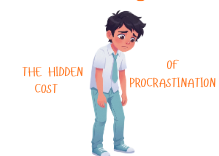
Procrastination may feel harmless in the moment, but its long-term effects are far more serious than most people realize.
First, it leads to significant productivity loss. Tasks that should take a few hours stretch into days or even weeks. Important projects remain unfinished, and progress slows down. Over time, this creates a gap between where you are and where you could have been.
It also results in missed opportunities. Deadlines are overlooked, ideas are never executed, and chances for growth quietly pass by. Many people do not fail because they lack ability—they fail because they delayed taking action when it mattered most.
As tasks pile up, stress begins to increase. Deadlines create pressure, and what could have been done calmly now becomes rushed and overwhelming. This constant cycle of delay and urgency can lead to mental exhaustion and burnout.
Perhaps more damaging is the effect on self-confidence. Each time you postpone something important, you send a message to yourself: “I cannot follow through.” Over time, this belief becomes internalized, and you begin to question your discipline, reliability, and capability.
Finally, procrastination reduces overall life satisfaction. Goals remain unachieved, potential feels unrealized, and there is a lingering sense of frustration—knowing you could do more, but not acting on it.
The truth is, procrastination does not just delay tasks—it slowly erodes your progress, your confidence, and your quality of life. And the longer it continues, the more expensive it becomes.
6 Practical Steps on How to Beat Procrastination

Understanding procrastination is important—but real transformation comes from taking consistent action. The goal is not to eliminate discomfort completely, but to reduce resistance and make starting easier.
Below are practical, research-backed strategies you can begin applying immediately.
1. Break Tasks Into Smaller Steps
One of the biggest triggers of procrastination is overwhelm. When a task feels too large or undefined, the brain perceives it as difficult and delays starting.
For example, a task like “Write an article” feels heavy and unclear.
Instead, break it down into smaller, actionable steps:
- Research the topic
- Create an outline
- Write the first draft
- Edit and refine
This approach reduces mental resistance. Each step feels manageable, and every completed step creates a sense of progress.
Small wins build momentum. And momentum makes it easier to keep going.
2. Use the 5-Minute Rule
Starting is often the hardest part of any task.
The 5-minute rule is simple:
Tell yourself, “I will only work on this for five minutes.”
This removes pressure and lowers the barrier to entry. The task no longer feels like a major commitment—just a small, temporary effort.
Psychologically, once you begin, something important happens: momentum builds. Your brain shifts from resistance to engagement, making it easier to continue beyond the initial five minutes.
In many cases, those five minutes turn into 20, 30, or even an hour of focused work.
3. Remove Distractions
Your environment plays a major role in your ability to focus.
If distractions are easily accessible, procrastination becomes almost inevitable. That is why it is essential to design your environment for productivity.
Practical ways to do this include:
- Silencing notifications on your phone
- Using website blockers for social media
- Keeping your workspace clean and organized
- Working in a quiet, distraction-free location
The goal is simple: make it easier to focus than to get distracted.
When distractions are reduced, your ability to start and sustain attention improves significantly.
4. Focus on Progress, Not Perfection
As I noted earlier, Perfectionism is one of the hidden drivers of procrastination. When you feel pressure to do something perfectly, you are more likely to delay starting.
To overcome this, shift your mindset from perfection to progress.
Instead of asking, “Is this perfect?” ask, “Is this done?”
An imperfect task that is completed creates value, builds confidence, and moves you forward. A perfect idea that is never executed does none of these.
Progress creates momentum. And momentum leads to improvement over time.
5. Set Clear Deadlines
Without deadlines, tasks can easily expand indefinitely. You must understand that deadlines create urgency and structure, which are essential for action. They give your brain a clear timeframe and reduce the tendency to delay.
You can use:
- Self-imposed deadlines
- External deadlines from work or school
- Accountability partners who hold you responsible
When you know there is a specific time limit, you are more likely to prioritize the task and take it seriously. One good thing about deadlines is that they turn intentions into commitments.
6. Use Identity-Based Discipline
One of the most powerful ways to overcome procrastination is to shift your identity.
Instead of relying solely on motivation, adopt a new self-concept:
- “I am someone who finishes what I start.”
- “I take action even when I do not feel like it.”
Behavior often follows identity. When you see yourself as a disciplined and reliable person, your actions begin to align with that belief.
Each time you complete a task, you reinforce this identity. Over time, consistency becomes natural rather than forced.
A Simple Daily Anti-Procrastination System
To make everything practical, here is a simple system you can start using immediately. It is designed to reduce overwhelm, increase focus, and help you take consistent action every day.
Start by identifying your most important task (MIT) for the day—the one task that will have the biggest impact on your progress.
Next, break that task into tiny, clear steps. The goal is to remove any ambiguity so your brain knows exactly where to begin.
Once that is done, set a timer and work for 25 minutes of focused effort (you can treat this as a single deep work session). During this time, eliminate distractions and commit to doing only that task.
After the session, take a short 5-minute break to rest and reset your mind.
Then, repeat the cycle.
This simple structure works because it reduces resistance, creates urgency, and builds momentum through small wins.
If you follow this system daily, you will notice something powerful: starting becomes easier, consistency improves, and procrastination gradually loses its grip on your life.
Conclusion: Progress Beats Delay
Procrastination is often misunderstood as laziness, but in reality, it is a psychological challenge rooted in emotional regulation. It is not that people do not want to take action—it is that something within them is resisting the discomfort associated with starting.
The first step to breaking this cycle is awareness. Once you understand why you procrastinate—whether it is fear, avoidance, perfectionism, or lack of clarity—you can begin to respond differently instead of reacting automatically.
More importantly, real change does not come from waiting for motivation. It comes from taking small, consistent actions, even when you do not feel ready. Each small step you take weakens the habit of delay and strengthens your ability to follow through.
Over time, these small actions compound into meaningful progress.
The goal is not to eliminate procrastination completely. That is unrealistic. The goal is to build the discipline to act despite resistance, to move forward even when motivation is low.
Because in the end, progress—no matter how small—will always beat delay.